
Concrete Septic Tank Corrosion: Why a Working Tank Can Still Fail Inspection
Can a septic tank fail inspection even if it still works? Yes. A concrete septic tank can continue accepting wastewater while corrosion weakens its roof, walls, or internal components. Significant deterioration may require repairs or replacement, depending on the extent of the damage, its location, and applicable county requirements.
Your drains work. There are no backups. As far as you can tell, your septic system is doing its job.
But wastewater flow tells only part of the story.
A concrete septic tank can continue functioning while its roof, walls, and internal components slowly deteriorate. You may not see any warning signs in your yard or notice anything unusual inside your home.
For homeowners throughout Colorado’s foothills and mountain communities, including Evergreen, Conifer, Morrison, Bailey, Pine, and surrounding areas, concrete tank deterioration is an important issue to understand, especially when preparing for a property sale.
For many homeowners, the first indication of a problem comes during a septic inspection, sometimes right in the middle of selling their home.
So how does this happen, and when does concrete deterioration become serious enough to require repairs or replacement?
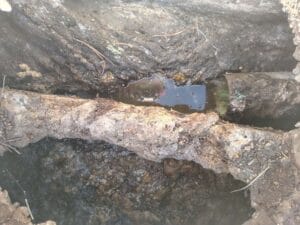
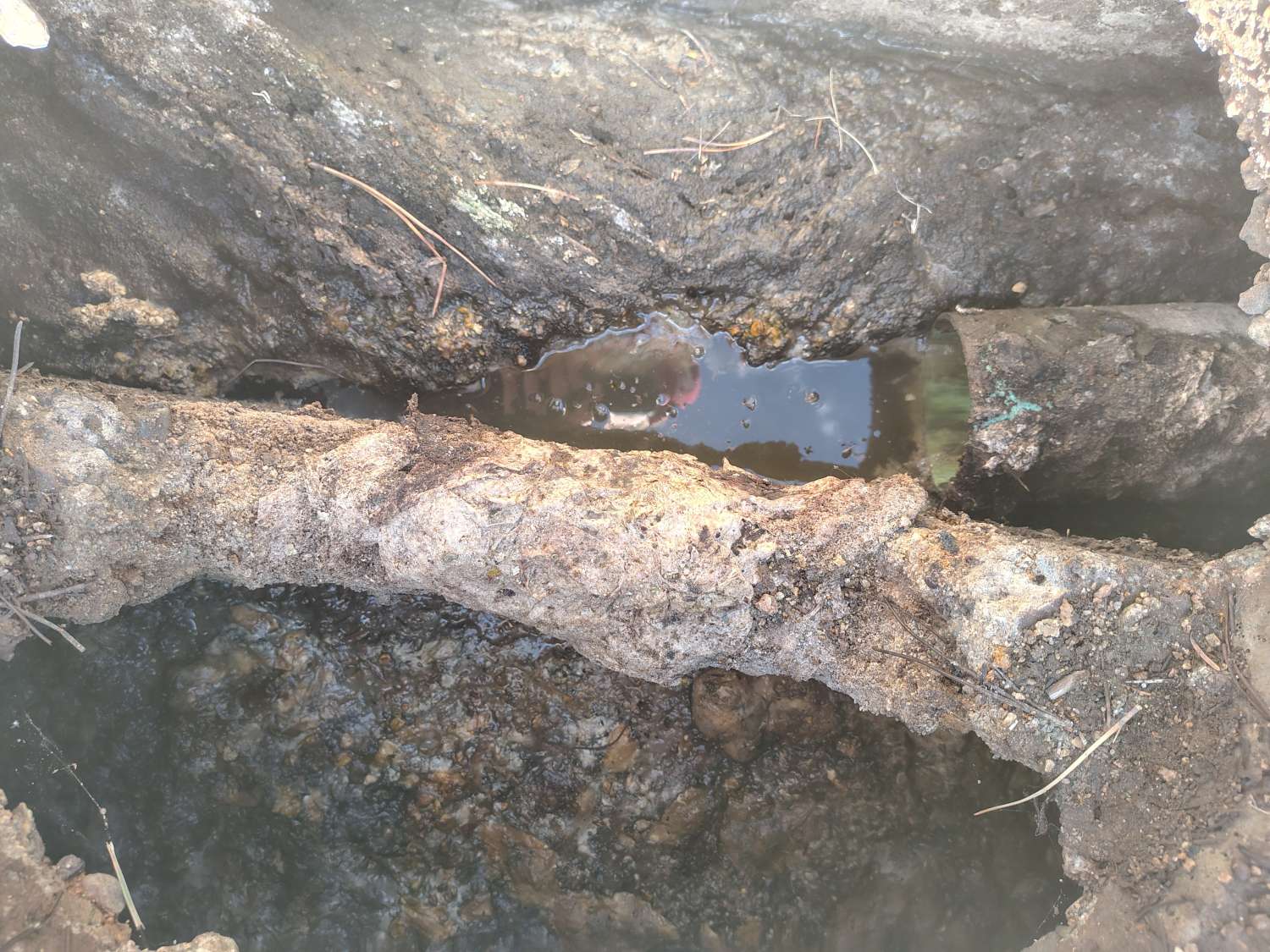
An internal concrete wall inside a septic tank has lost much of its cement surface, leaving rough, exposed aggregate. Determining how much sound concrete remains requires an inspection. Photo: South Platte Services.
What Causes Concrete Septic Tanks to Corrode?
An important cause of concrete deterioration in septic tanks is a process known as microbiologically induced corrosion.
As wastewater breaks down inside a septic tank, certain bacteria can convert sulfate in the wastewater into sulfide under low-oxygen conditions. Some of that sulfide enters the space above the wastewater as hydrogen sulfide gas.
When hydrogen sulfide reaches moist concrete surfaces where oxygen is available, other bacteria can produce sulfuric acid.
Over time, this acid attacks the cement paste that holds concrete together.
As the concrete deteriorates, it may:
- Become soft or crumbly.
- Develop a rough, deteriorated surface.
- Lose cement material, exposing the stones and aggregate inside.
- Lose thickness and structural strength.
This type of corrosion is commonly concentrated above the wastewater level, particularly on the underside of the tank roof and along the upper interior walls.
Deterioration may also occur around inlet and outlet pipes, baffles, and internal partition walls. Turbulent wastewater flow can increase the release of hydrogen sulfide gas, while damp surfaces provide conditions favorable to acid formation.
Importantly, corrosion can occur during normal septic system operation. It does not automatically mean a homeowner has neglected their system.
Not all concrete damage is caused by corrosion, either. Settling, loads from above, freeze-thaw cycles near the surface, poor original concrete, and installation problems can also cause deterioration.
The location and appearance of the damage help inspectors evaluate possible causes. Sulfuric acid corrosion generally affects interior concrete surfaces exposed to tank gases, while exterior deterioration may have different causes.
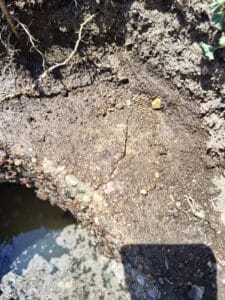
Exposed aggregate and cracking are visible in concrete near a septic tank access opening. Concrete damage can have several causes, which is why inspectors consider both the location and characteristics of deterioration. Photo: South Platte Services.
Why Does Corrosion Matter During a Septic Inspection?
A septic inspection evaluates more than whether wastewater flows through the system.
Inspectors also examine the condition of the tank itself, including its walls, roof, access openings, and internal components.
To function safely, a septic tank needs to remain structurally sound and watertight.
Significant deterioration can weaken the tank roof, damage internal baffles, compromise access-cover supports, and reduce the strength of the concrete.
In severe cases, deterioration of load-bearing areas can create a risk of structural failure.
A septic tank can continue accepting wastewater even when its structural condition is no longer sound.
That is why corrosion discovered during an inspection may require further evaluation, repairs, or complete tank replacement.
The severity and location of the damage, along with applicable county requirements, help determine what corrective action is necessary.
How Does South Platte Evaluate Concrete Deterioration?
At South Platte Services, our septic technicians evaluate concrete tank conditions during inspections throughout Colorado’s mountain communities.
Our technicians look beyond surface staining and discoloration. What matters is the condition of the concrete itself.
During an inspection, we evaluate accessible areas for softened or crumbling concrete, material loss, cracks, leaks, and deterioration around internal components and access openings.
One of the practical guidelines we use in the field involves the amount of sound concrete remaining.
When deterioration appears to have reduced the original sound concrete thickness by approximately 50%, we consider that a serious warning sign of potential structural compromise.
In these situations, South Platte typically recommends that the homeowner consult a qualified engineer to evaluate the tank’s condition and determine the appropriate next steps.
This is South Platte’s internal field guideline, not a county regulation or structural engineering standard. Less extensive deterioration can also be serious, particularly when it affects the tank roof, reinforcement, or access-cover supports.
The location and extent of the damage matter just as much as its depth. A localized deteriorated area near a baffle is different from extensive deterioration across the underside of a tank roof.
Our technicians document observable conditions, including photographs when practical, and explain their significance.
A routine septic inspection is not a structural engineering certification, and not every portion of a buried tank can necessarily be evaluated.
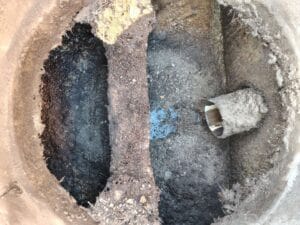
Looking down into a compartment of a concrete septic tank, visible deterioration has left portions of the concrete surface rough and uneven, with exposed aggregate. Photo: South Platte Services.
Does the Age of the Septic Tank Matter?
Yes, but age alone doesn’t tell us whether a tank is structurally sound.
The rate of corrosion depends on concrete quality, wastewater conditions, moisture, ventilation, and exposure to corrosive gases.
Some tanks deteriorate sooner than expected, while others remain in good condition for decades.
There is no reliable age at which every concrete septic tank begins to corrode or needs replacement.
The condition of the tank matters more than its age.
For homeowners purchasing older properties throughout Jefferson, Park, and Clear Creek Counties, this is an important distinction. An older tank is not automatically defective, but its condition should be properly evaluated.
Can a Corroded Septic Tank Be Repaired, or Does It Need to Be Replaced?
This is one of the most important questions homeowners can ask.
Not every defect discovered during a septic inspection requires replacing the entire tank.
Some problems, such as damaged baffles, access covers, risers, or other localized components, may be repairable without replacing the tank itself.
However, extensive deterioration of the tank walls or roof presents a different situation.
When substantial amounts of sound concrete have been lost, load-bearing areas have deteriorated, or the tank’s structural integrity cannot be established, replacement may be the appropriate solution.
Specialized repairs or protective coatings may be possible in certain circumstances, but applying a coating does not automatically restore the strength of deteriorated concrete.
The appropriate solution depends on the nature of the damage, the condition of the remaining tank, professional evaluation when necessary, and applicable county requirements.
If an inspection recommends replacement, it’s reasonable to ask what was found and why repair isn’t a suitable option.
A good inspection should help you understand the problem, not simply tell you that you need a new tank.
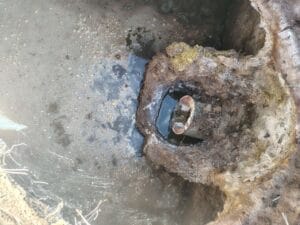
Heavy concrete deterioration is visible around a pipe opening inside a septic tank. Whether damage like this can be repaired locally depends on its extent and the condition of the surrounding concrete. Photo: South Platte Services.
What Should You Do if an Inspection Finds Corrosion?
If your septic inspection identifies deterioration, ask your inspector:
- Where is the damage located?
- How extensive is it?
- Can I see photographs of the affected areas?
- Does the damage appear to affect the tank’s structural integrity?
- Were any portions of the tank inaccessible or not visible during the inspection?
- Is repair a reasonable option, or is replacement recommended?
- Should a qualified engineer evaluate the tank?
- What county approvals or permits may be required?
These questions can help you better understand the findings and your options.
Planning to Sell Your Home?
Septic inspections can be particularly important during real estate transactions.
In Colorado’s mountain communities, property-transfer requirements vary by county. Homeowners, buyers, and real estate agents should understand the applicable requirements before a property changes hands.
Jefferson County
Jefferson County requires a Use Permit for qualifying property transfers involving septic systems, also known as onsite wastewater treatment systems (OWTS).
The process generally involves an inspection by a county-certified Use Permit inspector. Certain transfers may qualify for exemptions.
Homeowners should review the county’s current requirements and allow adequate time to address any deficiencies identified during the inspection.
For official forms, inspection guidance, and regulations, visit Jefferson County’s OWTS Forms and Planning Documents.
Park County
Park County has a Transfer of Title inspection process for qualifying properties served by septic systems.
The inspection evaluates the condition of the system and identifies deficiencies that may need to be addressed as part of the transfer process.
For county guidance, visit Park County’s Transfer of Title Information.
Clear Creek County
Clear Creek County requires a Use Permit for qualifying property transfers involving septic systems.
The process includes a third-party inspection, and the county reviews the system’s permitted capacity as part of the transfer requirements.
The county recommends beginning the process early rather than waiting until the closing date approaches.
For application information, visit Clear Creek County’s Use Permit Information.
Why Early Inspections Matter
Discovering a deteriorated tank early gives you more time to understand the problem, evaluate your options, and complete any necessary work.
This can be especially important in Colorado’s mountain communities, where winter weather and frozen ground may complicate inspections and repairs.
County regulations, exemptions, and permit procedures can change. Always confirm current requirements with the applicable county before a real estate transaction.
Can Homeowners Prevent Concrete Septic Tank Corrosion?
There is no simple household treatment that guarantees concrete corrosion will not occur.
However, proper septic maintenance helps protect the rest of your system and provides opportunities to identify deterioration before it becomes more extensive.
Pump and inspect your tank regularly. Pumping removes accumulated solids and helps protect the soil treatment area, commonly called the leach field. It also provides an opportunity for a professional to observe accessible tank surfaces and components.
Keep maintenance records. Previous pumping and inspection reports can help document the condition of your system over time.
Address identified problems promptly. Damaged lids, deteriorated components, and suspected leaks should be evaluated before conditions worsen.
Regular pumping is important, but it does not eliminate hydrogen sulfide production or stop established concrete corrosion.
Likewise, septic additives cannot restore concrete that has already deteriorated.
Avoid adding chemicals or making ventilation changes in an attempt to control corrosion without professional guidance.
Once significant concrete deterioration has occurred, ordinary maintenance cannot reverse the damage.
Common Questions About Septic Tank Corrosion
Can a septic tank pass inspection if it has some corrosion?
Yes, depending on the extent and location of the deterioration and applicable inspection requirements.
Minor surface deterioration does not necessarily mean the tank is structurally compromised. However, significant material loss, particularly in load-bearing areas, may require repairs, replacement, or additional evaluation.
Can a septic tank fail inspection even if there are no backups?
Yes. A septic tank may continue receiving and discharging wastewater while its concrete structure deteriorates.
Functional wastewater flow does not establish that the tank is structurally sound.
Does regular septic pumping prevent concrete corrosion?
Not necessarily. Regular pumping is essential for managing accumulated solids and protecting the soil treatment area, but it does not eliminate the biological processes that can produce corrosive gases inside a septic tank.
Are plastic or fiberglass septic tanks affected by the same type of corrosion?
Plastic and fiberglass septic tanks are not subject to sulfuric acid attack in the same way concrete tanks are.
However, these materials have their own potential failure modes, including cracking, deformation, installation-related damage, and problems with connections or structural support.
Regardless of the tank material, proper installation, maintenance, and inspection remain important.
A Note About Septic Tank Safety
Severely deteriorated septic tanks can present serious safety hazards.
A weakened roof, access cover, or supporting area may fail without an obvious warning, even when the household plumbing appears to operate normally.
Septic tanks can also contain dangerous gases and oxygen-deficient atmospheres.
Homeowners should never enter a septic tank, lean into an open tank, stand on a damaged cover, or attempt to test deteriorated concrete themselves.
If you suspect a tank or access cover is structurally compromised, keep people, pets, and equipment away from the area and contact a qualified professional.
If someone falls into a septic tank, call 911. Do not enter the tank to attempt a rescue.
Protecting Your Septic System in Colorado’s Mountain Communities
At South Platte Services, our roots in serving Colorado’s mountain communities extend back more than 50 years, including our history as Shirley Septic Pumping.
Our septic team provides pumping and inspection services throughout Jefferson, Park, and Clear Creek Counties, including Evergreen, Conifer, Morrison, Bailey, Pine, and surrounding areas.
Whether you’re preparing to sell your home, purchasing a property, or keeping up with routine maintenance, understanding the condition of your septic tank can help you avoid unexpected problems.
Did your septic inspection report identify concrete corrosion?
Contact South Platte Services. We can help you understand the findings, discuss potential next steps, and determine whether additional evaluation may be appropriate.
And if you’re simply due for routine septic maintenance, regular pumping and inspections are an important part of keeping your system in good condition.
South Platte Services | Serving Colorado’s Mountain Communities for Over 50 Years