

South Platte Services · Serving Evergreen, Conifer, Bailey, and the Colorado foothills
It’s one of the most common questions we get from homeowners up here. And the answer surprises most people.
Your tank is supposed to be full
A healthy septic system runs at a consistent liquid level all the time. As water comes in from the house, the same amount flows out through the outlet baffle into the leach field. Water in, water out. The level doesn’t change.
Think of a bathtub with an overflow drain built into the side. The water never rises above that drain because anything extra just flows out.
So when we open a tank during a pump-out and it’s full of liquid, that’s normal. That’s what it’s supposed to look like. What we’re actually checking is where that liquid sits relative to the outlet baffle.
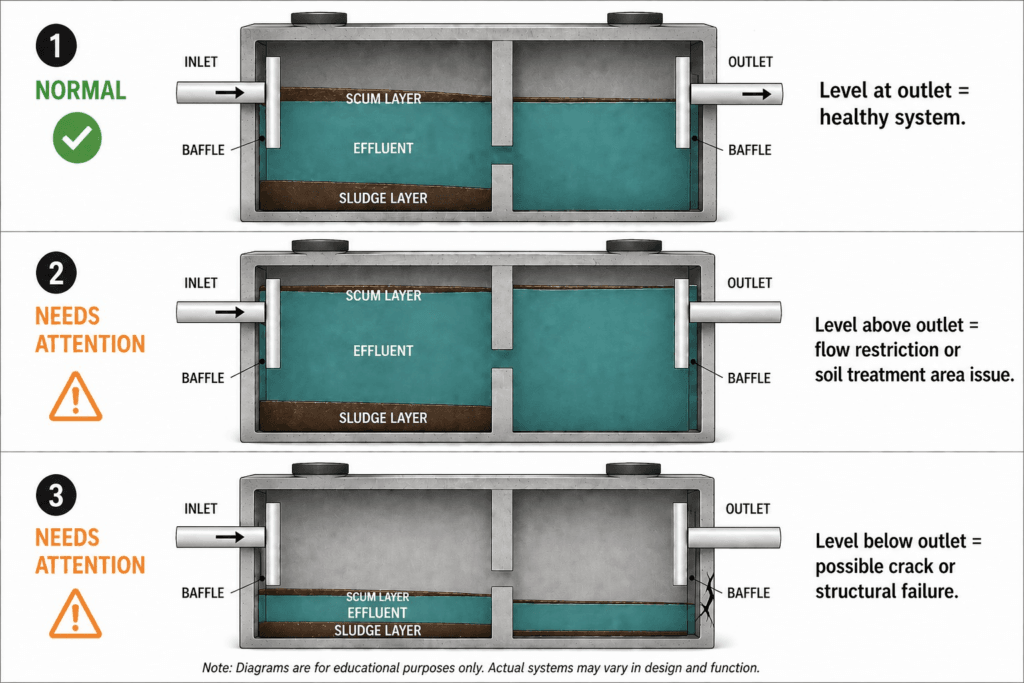
What the liquid level actually tells you:
Level
What it means
At the outlet
System is flowing as designed. No immediate concern.
Above the outlet
Flow restriction somewhere — clogged outlet, blocked line, or the soil treatment area isn’t accepting flow. A pump-out alone usually won’t fix this.
Below the outlet
Liquid is escaping somewhere it shouldn’t. Possible crack or structural failure.
The warning sign isn’t a full tank. It’s a level that’s moved in either direction. If we open a tank and the level is above the outlet, we’re not just going to pump it and leave. That’s a diagnosis problem, not a maintenance problem. A failing soil treatment area is a separate issue, and a much more expensive one.
What a normal level doesn’t tell you
Here’s what catches a lot of homeowners off guard. Even when the liquid level looks perfectly fine, the tank can still be overdue for service.
While liquid is flowing in and out continuously, the tank is also doing something else: separating solids. Heavy material sinks and builds up as sludge on the bottom. Lighter material floats and accumulates as scum on top. In between, relatively clear liquid moves toward the outlet.
What’s actually inside your tank:
Scum layer — fats, oils, and light solids floating at the top
Effluent — the relatively clear liquid that exits to the soil treatment area
Sludge layer — heavy solids that settle and compact at the bottom
Over time, sludge and scum build up and shrink the working volume of the tank. Once solids reach the outlet level, they start moving into the soil treatment area. That’s when a maintenance issue becomes a repair bill. And repairs to a soil treatment area cost significantly more than a routine pump-out.
A liquid level that looks normal tells you nothing about how much capacity has already been lost to buildup. That’s why we recommend staying on a service schedule even when everything seems fine. For most mountain homes in Evergreen, Conifer, and Bailey, that’s every two to three years, though household size and usage matter too.
Warning signs you’ll notice above ground
The symptoms people call us about — slow drains, backups, odors — don’t all point to the same place. Knowing what you’re seeing helps us figure out what’s going on faster, sometimes before we even show up.
Slow drains or sewage backing up
If it’s one fixture, one slow sink or toilet, it’s usually a line clog. Annoying, but straightforward. A blockage at the inlet baffle is another possibility, and that typically means the tank hasn’t been pumped in a while.
If the slow drains are affecting multiple fixtures throughout the house, the problem is further downstream. The tank may be at capacity, the outlet baffle may be restricted, or the soil treatment area may not be taking flow properly. That one needs a proper look before anyone starts guessing at fixes.
Wastewater surfacing in the yard
If you’re seeing wet spots or sewage surfacing near the tank or soil treatment area, the system isn’t dispersing the way it should. Could be a saturated or failing treatment area, an outlet restriction, or a tank that’s well overdue for pumping. Whatever the cause, it needs attention right away. Letting it go makes it worse and more expensive.
Odors
Septic odors near the system come and go. Seasonal changes, temperature swings, barometric pressure shifts can all cause occasional smells that don’t indicate anything’s wrong. If the odor is persistent, getting stronger, or showing up along with other symptoms, call us. Occasional odors by themselves aren’t always a red flag, but they’re worth paying attention to if they stick around.
When you do call, tell us which drain, which fixture, whether it’s one spot or the whole house. The more specific you are, the faster we can narrow it down.
The bottom line
A full tank is fine. A steady level is fine. What’s not fine is a level that’s shifted, or a tank that hasn’t been serviced in years.
Most major septic failures don’t happen overnight. They build up slowly, over time, until something gives. Catching the problem early is the difference between a service call and a repair that runs into the thousands. For properties up here in the foothills, staying on a maintenance schedule is the simplest thing you can do to protect a system that’s expensive and sometimes very difficult to replace.
Not sure where your system stands?
We’ll take a look, tell you exactly what we find, and let you know whether it’s routine or something that needs attention now. South Platte Services has been serving Evergreen, Conifer, Bailey, and the Colorado foothills for over 50 years. Family owned, locally operated.
Call 303-838-6033 · SouthPlatteServices.com
Categories: Septic basics · Evergreen CO · Conifer CO · Bailey CO · Foothills septic service · Mountain properties